
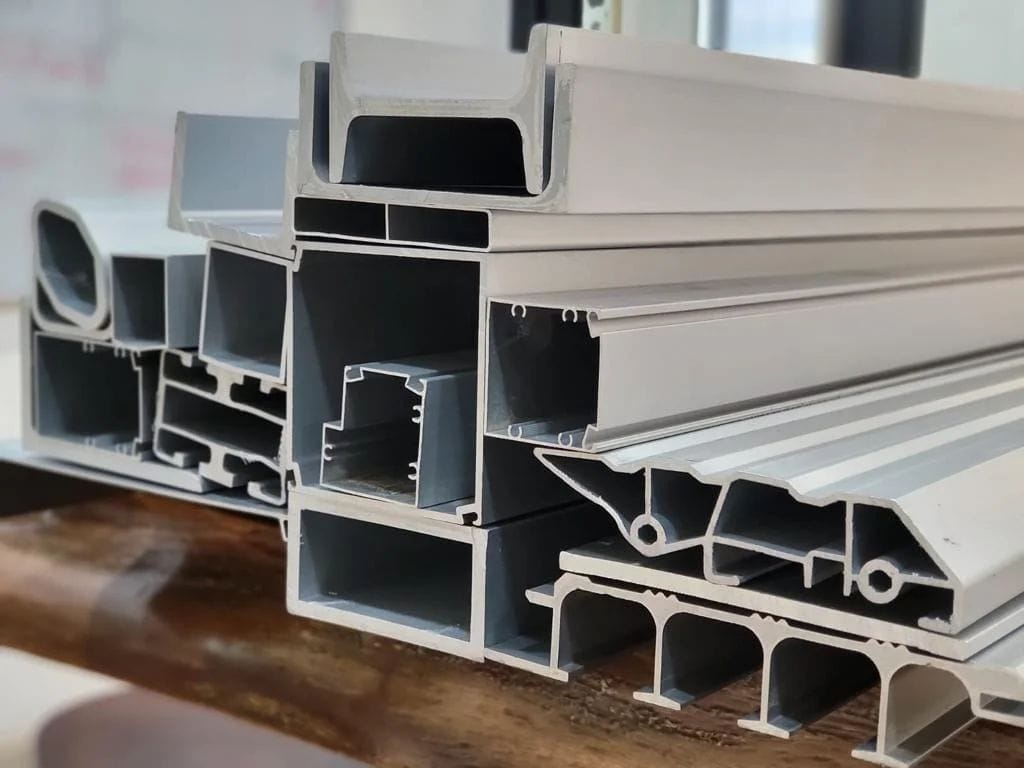
Understanding the aluminium extrusion process is essential for buyers who prioritize consistency, precision, and long-term supply reliability. Each stage in the process directly affects the final profile’s strength, tolerance, and surface quality, making process control a key factor when selecting a supplier.
The process begins with aluminium billet preparation, where the alloy composition is carefully controlled to ensure uniform structure and stable extrusion performance. High-quality billets, especially those produced in-house, provide a stronger foundation for consistent results across multiple production batches.
The billet is then heated to an optimal temperature to allow smooth metal flow during extrusion. Proper heating reduces the risk of cracks and defects while maintaining the material’s mechanical properties, which is critical for industrial applications.
During the extrusion stage, the heated billet is pushed through a custom-designed die under high pressure, forming the required profile shape. This is the core of the aluminium extrusion manufacturing process, where precision, die quality, and press capability determine dimensional accuracy and repeatability.
After extrusion, the profiles undergo controlled cooling or quenching, either by air or water, to lock in the desired mechanical properties. This step is important to prevent deformation and ensure consistent strength throughout the profile.
The profiles are then stretched and straightened to remove internal stress and improve alignment. This stage ensures the profiles meet strict dimensional tolerances and remain stable for further processing or installation.
Once straightened, the profiles are cut to the required length based on project or export specifications. Clean and precise cutting ensures compatibility with downstream fabrication processes.
Heat treatment, typically in T5 or T6 condition, is applied to enhance the mechanical strength and durability of the aluminium profiles. This is particularly important for structural and load-bearing applications.
Finally, surface finishing processes such as anodizing or powder coating are applied to improve corrosion resistance and visual appearance. These finishing treatments are essential for products used in outdoor or architectural environments.
For B2B buyers, a controlled extrusion process ensures consistent quality, reliable specifications, and stable supply across shipments. ALCA Metals, based in Indonesia, supports global markets with a fully controlled aluminium extrusion process from billet to finished profile.